
The Landings Association 50th Anniversary
50th Anniversary Grand Finale Celebration Rescheduled for September 24 at Landings Harbor from 3 to 7 p.m.
Due to the forecast for heavy rain on Saturday (September 10), the 50th Anniversary Grand Finale Celebration has been rescheduled for September 24 from 3 to 7 p.m at Landings Harbor Marina.
This event will be worth the wait, so mark your calendars now. There will be live music, food vendors, kids’ events, a pop-and-pour bar provided by The Landings Golf & Athletic Club, and more. Please watch for Landings Association emails with more details as they become available.
Thank you to our event sponsors, The Landings Company, Nicole Casino, and Comcast/Xfinity. If you think these first 50 years were great, just wait until you see the next 50!
#CheersTo50Years!
Resident Videos
Stephanie Giorgio Shares Memories of Growing Up in The Landings
Maryce Cunningham Reflects on How Her Family Chose The Landings
Bag Packing Bonanza
at TLA
Lisa Olson Shares What She Enjoys About Life in The Landings
Merchandise
Lisa Olson Shares What She Enjoys About Life in The Landings
50th Anniversary Image Gallery
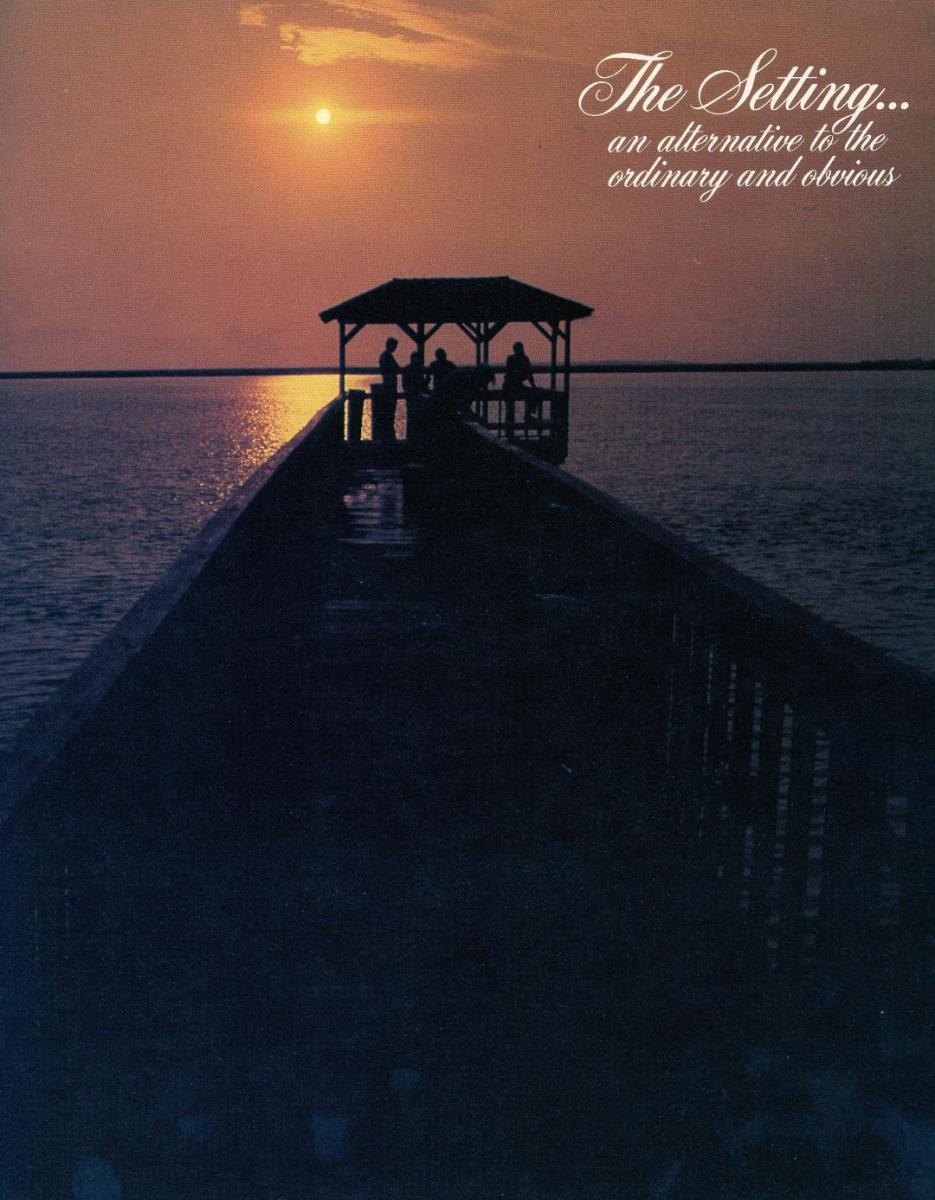
This picture, courtesy of Ron Weller and Noel Wright, is the old Union Bag original wooden Priest Landing dock before Landings Harbor Marina was built. Union Camp had a hunting lodge on Skidaway Island, and they used to bring executives to the island to hunt deer and hogs long before the bridge was built. Noel knew Hank Haines, who was the woodlands manager for Union Bag, so he got invited to hunt and bring trail dogs as a favor to Hank. Noel crossed that dock with his deer hounds many times to hunt with the Union Bag groups of hunters brought down from inland counties, where the company had pineland forests. Members of the groups were politicians who had the authority to set real estate tax rates on Union Bag land. Noel would spend the night in Clayton Davis’s (UB caretaker) shack. The sleeping was not very comfortable – they slept on the bare floor! Clayton always had two or three semi-wild horses that they would ride and drive the dogs with. Clayton had a son named Duck Davis, who worked at the UB main plant, and Duck would often hunt with them. Hunting stopped after the bridge was built in 1972.
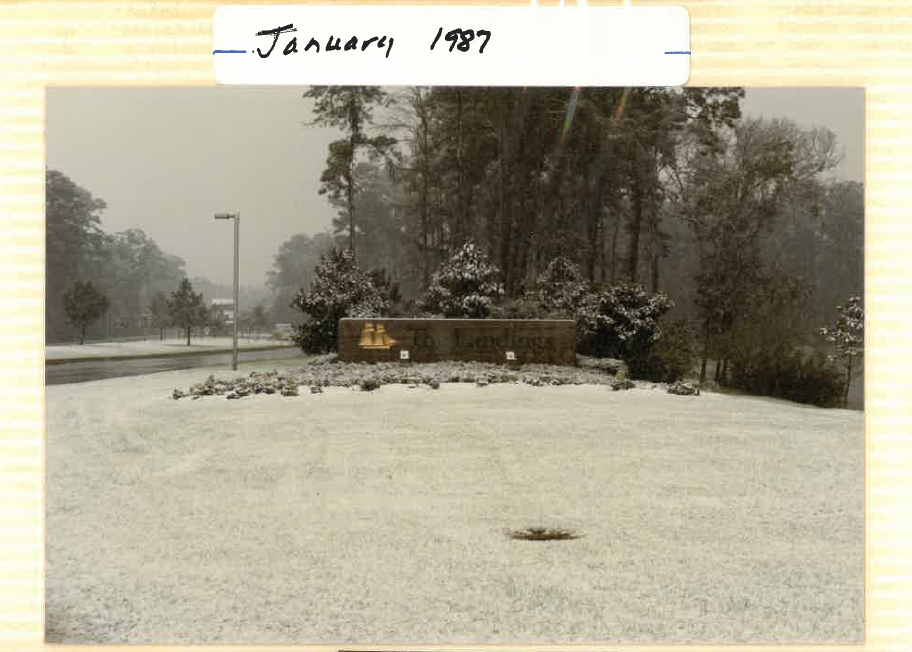
A light dusting of snow covered the entrance sign of The Landings in January 1987.
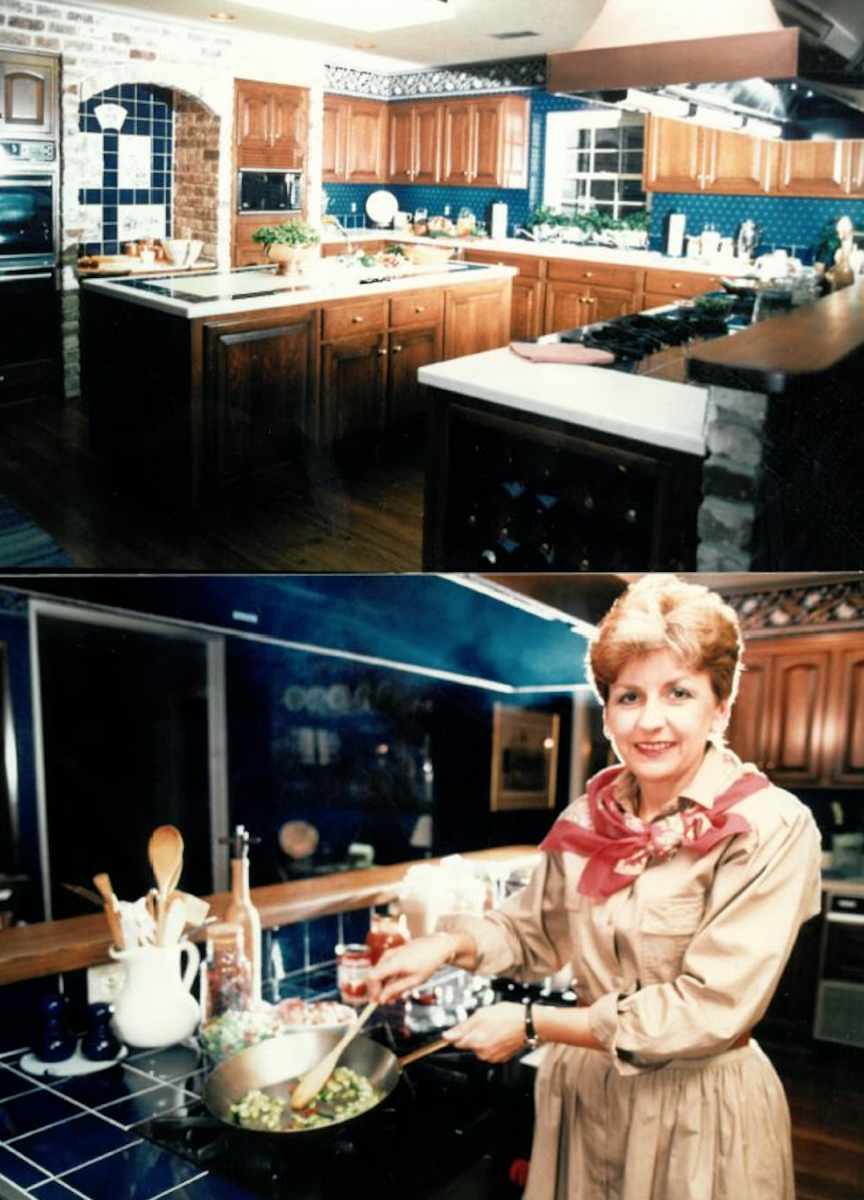
Pat and Howard Hackney were the first to get Natural Gas in The Landings at their residence on Chatuachee Crossing. In 1987, they started a major home renovation and built a gourmet kitchen. The kitchen took a year to plan and complete and included five commercial gas cooktops, each with 20,000 BTUs; a commercial Custom Cooper Hood, antique Chinese Tiles purchased by Howard in China; and a Georgia Pink Marble Pastry Center with Savannah Grey Brick surround. This was during the cooking and home entertainment wave of the 80s. The kitchen also boasted heart pine floors, custom cherry cabinets, and beveled glass. The Hackneys sold the house in 1995 and now live in Oakridge. It is their understanding that the kitchen on Chatuachee Crossing still is just as it was designed.
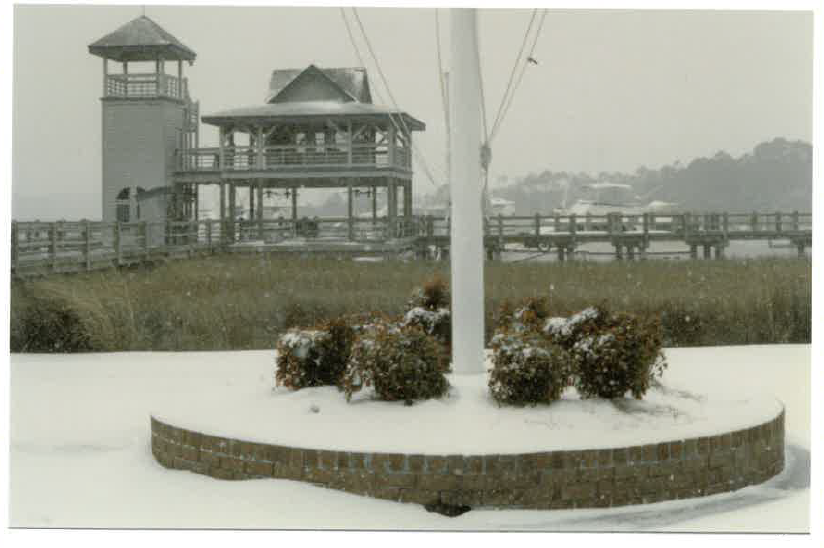
Delegal Creek Marina decked out in snow in the late 1980s.
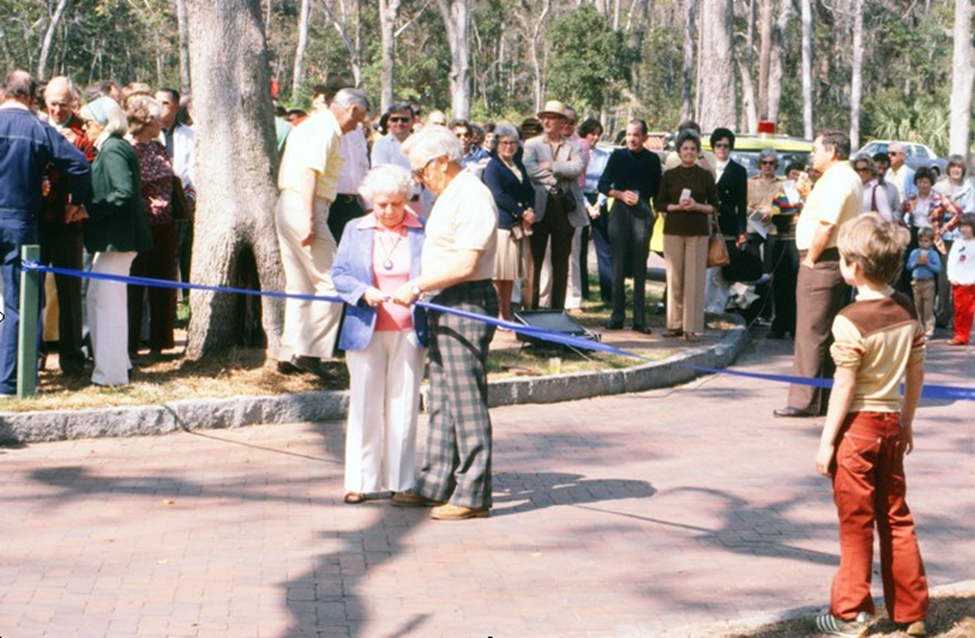
Who were the first residents of The Landings? That distinction belongs to Elbert and Helen Little, who bought their lot in 1972, built their own home at 4 Tything Man Lane, and moved into it in 1973, claiming Club Membership #14!
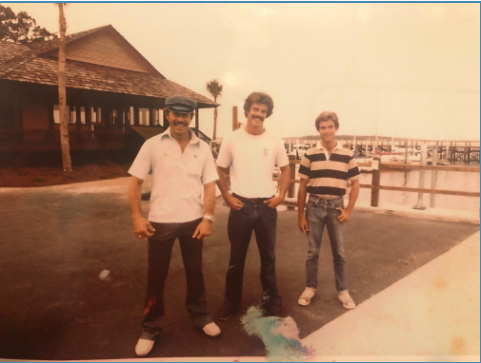
Longtime Landings Association employee Mike Bousquet (center) poses with friends at Landings Harbor Marina back in the early 80s.
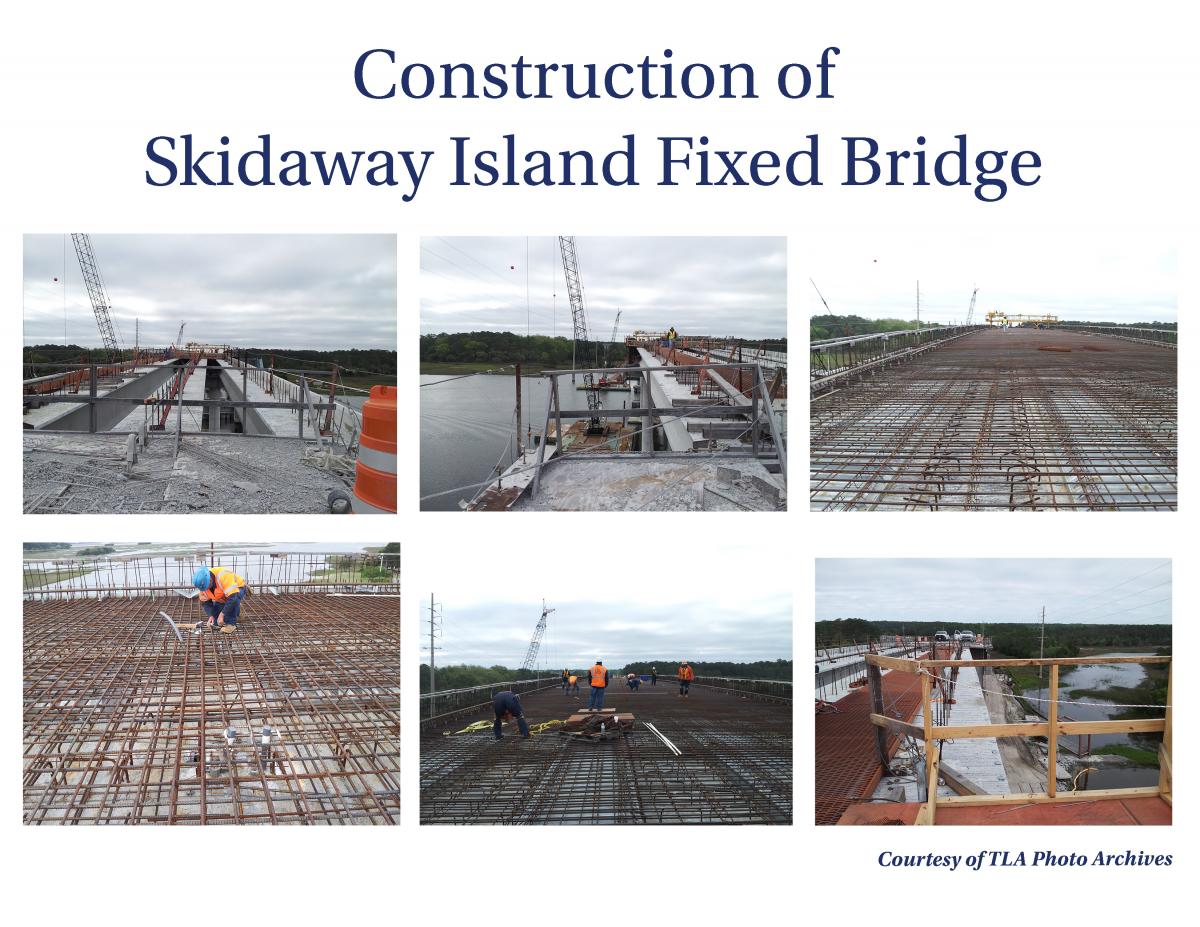
Bridge Collage
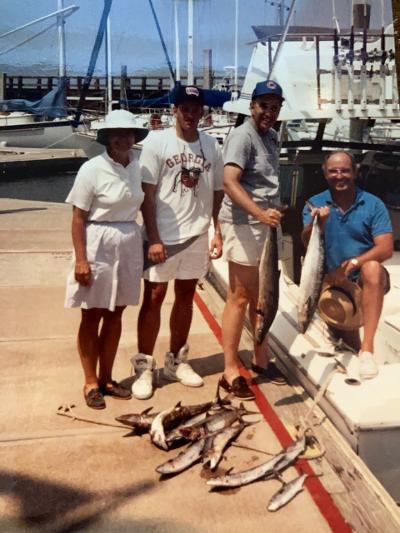
Brent Woody Musburger (former ABC Announcer with Howard Cosell) and family experience a good day fishing in the 1990’s with Captain Bob Morrissey.
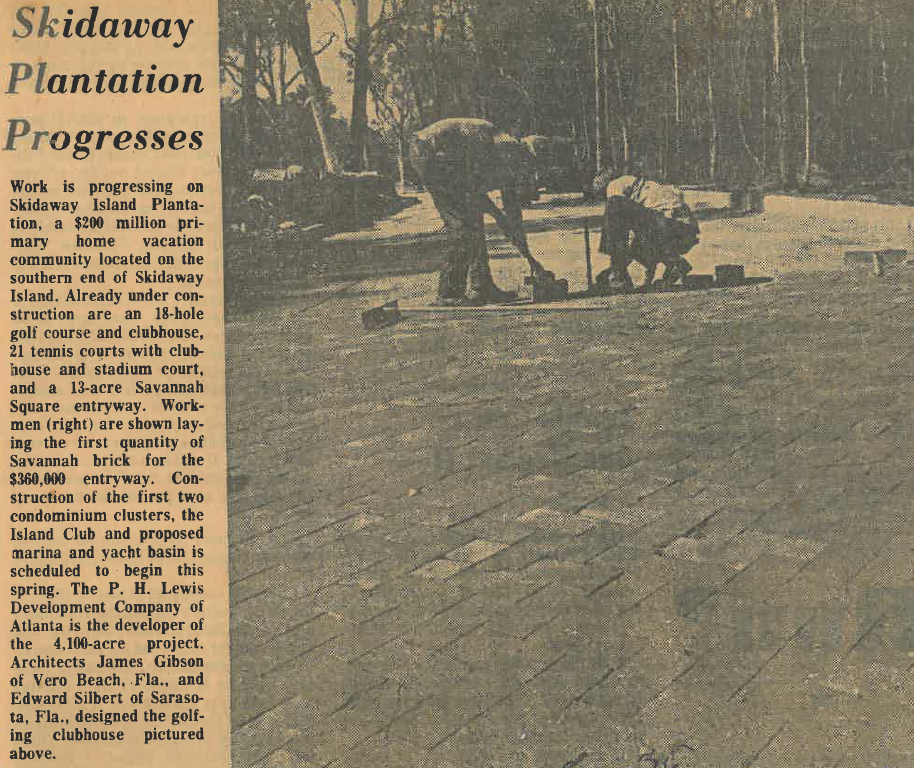
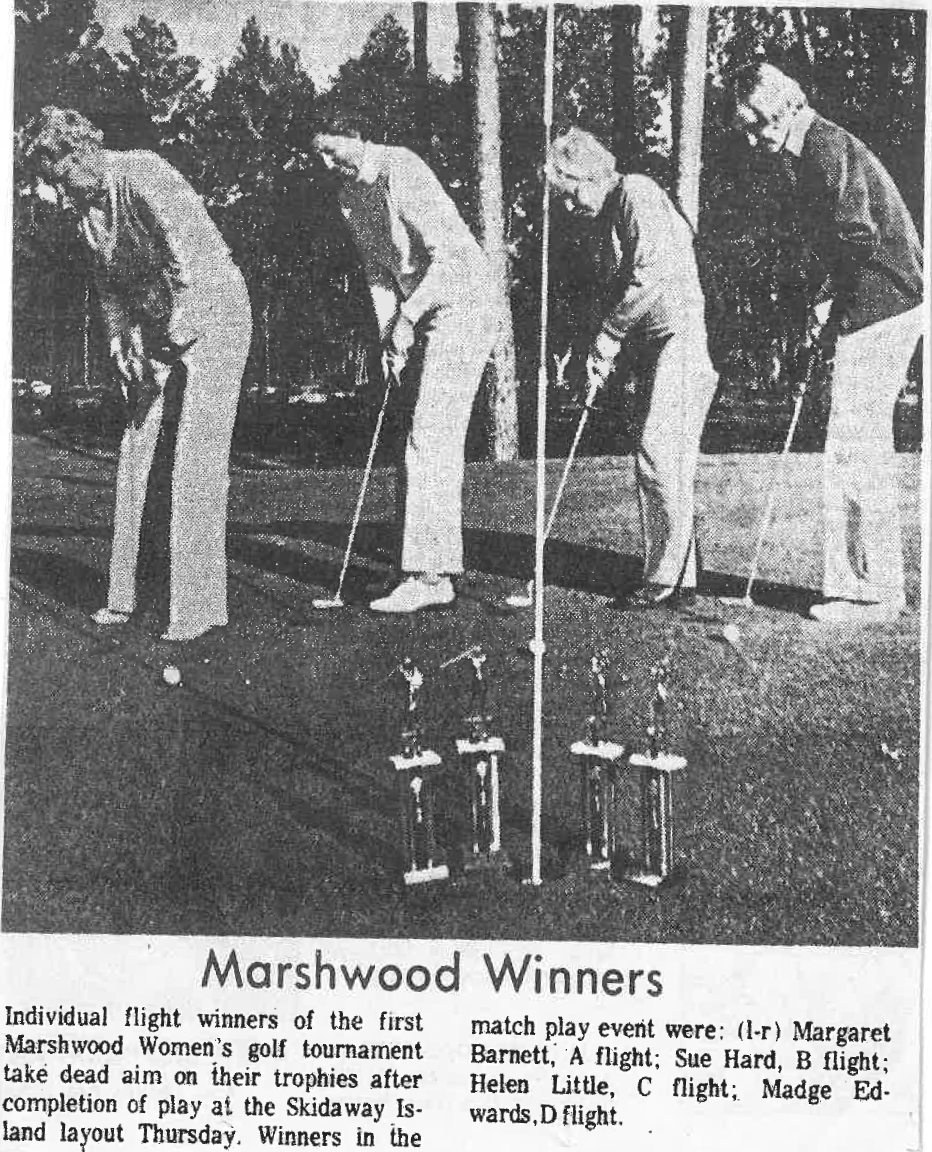
This newspaper clipping, shared by Sue and Sonny Jones, talks about the progress of The Landings (Skidaway Plantation) in the early years. Click on the image to enlarge and read it.
Resident Poems
Skidaway
A Poem By Richard Burke
On either side the island lie
Marshland wide and river nigh,
That bound the land and please the eye;
And or’ a bridge a road runs by
To tranquil, verdant Skidaway;
Where up and down the golfers go,
On their carts with clubs in tow,
Round the fairways to and fro,
On golf embowered Skidaway.
But Dina and Rich nor chip nor putt,
Nor sail in waters that abut
Marshlands where blue heron strut
And rise and fall and twist and cut
Flowing down to Skidaway.
What do they then to pass their days
In pleasant and amusing ways
On this Isle of tranquil laze,
This golden isle of Skidaway?
Films to watch and books to read,
Deer to chase, birds to feed,
Home repairs when there is need,
But from wearying work now freed,
Retired at last on Skidaway.
Three miles each day in sun or rain
They stroll along both path and lane
That pierce the forests of their domain,
Their lush domain of Skidaway.
And sitting down to morning meal,
See heron stalk and osprey wheel,
Hoping from the marsh to steal
Crab or mussel, fish or eel
Along the shores of Skidaway;
And once each month, to their delight,
Watch Moon conspire with the night
To bathe waters dark in golden light;
Moonlight beams or’ Skidaway.
Part II
On a bluff ‘bove coastal water,
Settler, wife, son, and daughter,
General, cleric, merchant, pauper
To virgin forest brought new order
Two hundred years ‘fore Skidaway.
Streets laid out in simple grid,
Lawyers, slaves both here forbid,
Tomochichi ‘Welcome’ all did bid,
Fifteen miles from Skidaway.
Tything lots for cottages planned;
Public buildings on Trust lots stand;
Squares for fire breaks, pasturing and
In times of trouble, militia manned,
One day’s march from Skidaway.
Still preserved those arbored Squares,
Protected now by Settlers’ heirs,
Scenes for weddings, scenes for fairs,
To harm them now no mortal dares,
Not even one from Skidaway.
In and about those Squares renown,
Dina and Rich can oft be found
Enjoying all the sights and sound
And entertainments that abound
A little north of Skidaway.
Two centuries passed, yet still the call,
Tomochichi’s ‘Welcome’ to us all,
Embrace the city, forsake the mall
Tho’ it be nearer Skidaway!
The Landings of Skidaway Island
By Philip R. Viviani, Ph.D
The Harry S. Truman Parkway is where,
Whitefield Avenue will take you there.
Move off the exit turning right,
Passing a couple of traffic lights.
Moving down the Diamond Causeway,
The marshes begin to show the way.
Passing Pin Point Drive you will shortly see,
An American Flag floating in the breeze.
The Moon River Bridge is not too long,
To remember Mercer’s beautiful song.
Then up the Boat Ramp Bridge we go,
To where The Landings start to show.
To the left and right you will see,
The wonderful marshes of the sea.
The Inland Waterway makes its way,
North and South and every way.
So off the ramp you go,
To find an entrance, go very slow.
A Main Gate can let you in,
Staffed by pleasant women and men.
The roads throughout lead the way,
For you to enjoy a beautiful day.
Majestic Oaks and Pines reach for the sky,
A pleasant sight for every eye.
The Oaks send out their limbs,
For the Spanish Moss to dance in the wind.
There’s flowers and colors galore.
With plantings of many more.
There’s many a’lagoon throughout,
So you can see Egrets lurch about.
Ducks and Herons join the crowd,
With many a’fish to be devoured.
The Mariners are such a sight,
Just sit and enjoy the waters bright.
Boats move in and out,
While others are moored about.
Children laugh and play,
As they catch their seafood prey.
Everything seems so right,
For such a pleasant sight.
Look to the West,
For a beautiful Sunset!
What a wonderful way,
To end a beautiful day.
50TH Anniversary Scavenger Hunt
Test your knowledge about The Landings by solving the clues of our 50th Anniversary Family Fun Day Scavenger Hunt. We highly recommend you visit each location and enjoy all each has to offer. The first 50 participants to complete the hunt should email #CheersTo50Years! to pr@landings.org to be entered into a random drawing. The deadline to email to be entered into the drawing is May 30. Three winners will be selected and announced in Landings Notes & News.
Calendar of Events
May 15 at noon – Golf Cart Parade, Scavenger Hunt, Celebration (Route TBD)
50 Things Parade – Participants to decorate their golf carts with 50 things
June 25 – 50th Anniversary Landings Night at the Ballpark
- Click here to purchase tickets now! On this evening, the Savannah Banana’s will take on the Macon Bacon. You do not want to miss this exciting event!
July 4 – Community Independence Day Celebration
Collaboration with The Landings Club to include fireworks and a community picnic.
September 10 – Grand Finale (Rain Date is September 24)
Timelines
September 10 – Grand Finale (Rain Date is September 24)
This timeline carries you through the years and highlights some of the trends in food, fashion, movies, and more. It was compiled by residents Maryce Cunningham and Lisa Olson.
This timeline takes you on a journey from the 70s to the present, offering historical information about The Landings and neighboring areas. It was compiled by Richard Burke.
Individuals Who Helped Shape The Fabric of Our Community
Gayle Crawford Recounts Early Life in The Landings

As I continue my interviews for The Landings’ 50th anniversary celebration year, Gayle Crawford (pictured at left) stepped forward and said, “I have some stories!”
Gayle and her husband Ron built their house in 1973 and moved in on New Year’s Day in 1974. She told me it was the sixth house in the Landings, at 3 Captain Dunbar Lane (one of the many captains who “reside” in Marshwood). They were on Burnside Island and would take their bikes or Jeep over the bridge. There were still logging trails evident. Her house backed up to the big long lagoon (one of the longest on the island). When they bought the lot, the lagoon was only three feet wide – it was just beginning to be dug. Their house was very isolated; they couldn’t see any houses across from or next to them. It was very dark at night, and one night there were loud, wild cat noises. They had a balcony off the master bedroom. Her husband went out and yelled, “Shut up!!” Of course, the cat didn’t. She said Bob Duffy was the first president of TLA, and her husband was Treasurer. Some fun at the Marshwood Clubhouse were fish fries and bingo. One time, Bob and his wife were coming down the cart path behind the Crawford’s house. Bob’s wife saw a water lily in the lagoon and really wanted it. Bob leaned down to reach it, and all of a sudden, an alligator came running out of the woods to jump in the lagoon. Now, you don’t expect to see a gator BEHIND you!
Gayle talked about the concern with the real estate crunch in1974, when nobody was building. Her husband said, “Well, they’re not going to blow up the bridge.” He felt they would be fine, and things would recover. She tells the story of seeing two deer on the other side of the lagoon. At that time, deer were puzzled by seeing people on the island (they apparently got over that). The deer started swimming across, and all of a sudden, the doe went straight up in the air into the jaws of a giant alligator! I said “ick!” when she told me that, but we both agreed that’s nature. Gayle believes Branigar did everything they had promised and more in terms of development.
They used to bike to the Harbor and sit on the rocking chairs on the porch and have a drink. One night, she reported that some men drove up, all dressed in black and some with diving suits and flippers, with machine guns. They jumped into a boat and took off! She and her husband just stared at each other. Come to find out that Jimmy Carter was going to be visiting Ossabaw, and the men were Secret Service checking things out ahead of time. Imagine having seen that!
They lived in The Landings for 13 years, and her boys grew up here. In 1987, they bought what had been Johnny Mercer’s house on Moon River and lived there for nine years. One day, there was a white sedan and station wagon in her driveway. She went out to see what was going on. It was Hugh Mercer (Johnny’s brother). He had just picked up Ginger (Johnny’s wife) from the airport, and she said she wanted to just look at the house one more time.
Gayle and her husband retired to the mountains and then came back and lived on Sky Sail Circle for four years.
These were certainly stories I’ve not heard from anyone else. Thanks, Gayle, for entertaining us!
Sonja Byrd Remembers Early Life in The Landings

I have enjoyed interviewing several of our longer-term residents during this year of celebration of the 50th anniversary of The Landings. Recently, someone told me about a person just down the street from me, who is a real Landings treasure.
Sonja Byrd (pictured at left) is originally from Savannah, growing up on DeRenne Avenue, which was a dirt road at the time. There were five houses between Skidaway Road and White Bluff Road. It was white sand and a real struggle to ride her Schwinn bike on it. There was an area that had cows (she thinks part of Starland Dairies) where the Fairway Oaks area is now. She tells of a giant hole that became filled with water, and they swam in it, even though her mother was very afraid for the children to do so. Sonja said one day, her brother surfaced from under the water, with mud all over him (sounds to me like Creature from the Black Lagoon!). She said it upset her mother greatly, and she took a switch to him. Sonja also lived in South Carolina for awhile. She told me she was named after Sonja Henie, the Norwegian Olympic skater. She had dimples as a baby, and when the doctor handed her to her mother, her mother said she looked just like Sonja Henie. Then Sonja looked at me and said, “but I don’t skate”. Her parents owned Warren Exterminating, which was one of only two exterminating companies in Savannah at the time. Her father sold the company to Mrs. Yates (so it is now Yates-Astro).
Her second husband, Benjamin Tillman “Cookie” Byrd, was the former owner of the Byrd Cookie Company (second generation). She tells the story of Mr. Byrd, Sr., who lived in South Carolina. His uncle had a small grocery store here, so Mr. Byrd moved to Savannah and met Mrs. Byrd. They lived on Norwood, and had a big garden and a cow. Sonja’s husband said as a boy, they were never hungry but he got tired of eating dried beans. Mr. Byrd, Sr. worked for Derst Baking Company, and Saturday was their big delivery day. He wanted to join the Seventh Day Adventist church, which held worship on Saturdays. So he wanted Saturdays off, but the company said no. So, he went back to see his mother in South Carolina and learned how to make oatmeal cookies. He’d drive around in his Model T truck and sell them. That was the beginning of the famous Savannah cookies.
Sonja’s husband was in the Flying Tigers in World War II. They flew over the Himalayas (“the Hump”) without maps or knowing the true height of the mountains, to bring supplies to China, which was barricaded by Russia and Japan. Growing up, her husband swam in the Moon River Creek and knew the Mercer (yes, Johnny Mercer) family.
They built the first house on Ward Lane in 1978. They paid $16,000 for their lot. Building had to be accomplished via a generator, as there was no electricity on the island yet. At the time of the building, of course, there was only the drawbridge. She said when they went into town, you didn’t see another car coming or going. If they did end up passing somebody, each car’s driver would roll their window down and wave. Sonja reported that people were upset when reading in the Savannah Morning News that the sales tax would be raised one cent to pay for the road and the bridge. Sonja said she was after her husband to buy one or two water lots (they were $25,000), but he said he didn’t really know where the island was going longer term, so he didn’t want to. She said, “He bought a Corvette instead.”
When The Village came, she said she was hoping for shops, shoes, and clothing. She said “instead, we got five banks!” There was one ladies’ clothing store there at one time, but it didn’t last. Early on, Landings Harbor was there, but there were no boats yet in the marina. Sonja’s husband had a yacht in Thunderbolt. The Landings told him “if you bring it here, we will give you free docking for one year.” Their Club number was 3, and they paid $25 a month in dues. She said the last time she used it in one of the restaurants, the waiter couldn’t figure out if it was a real number. He went off to the computer, came back, and apologized.
Sonja’s current home is the pink Queen Anne style on Priest Landing Drive near Landings Harbor. That lot was $50,000 at the time. This is her second home in The Landings, and she has lived in it for 22 years. Her husband drew up the plans with his uncle. She loves having the woods behind her and told me that she has a sign out back that says “Byrds of Paradise.”
It was such fun talking with Sonja, and she left me with two great quotes:
- “I swell with pride that I’m 85, and people say I look 45.”
- “I don’t have a fax, cell phone, or email. I have a life.” (Love it!)
Karen Dove Barr Reflects on Life in The Landings During the Early Years

Karen Dove Barr (shown at left) and her husband purchased their lot on Brisbane Court in Tower Point in 1985. They initially rented in the “historic part of the community”, The Settlement (the townhomes on Dame Kathryn Drive), while they were building their house. At the time, Tower Point was just opening up, and there was a road going through their lot. Karen said there was a plan to have condos near the Marsh Tower. Since there was no ocean view, the expansive view of the marsh would have been desirable. Luckily, that did not occur. She had lived in Savannah for a while, and neighbors from Windsor Forest had moved here. She recalls that there were more oaks in Tower Point than pine trees. When the footings for their house were dug, pieces of blue and white pottery were found.
At that time, Landings Way South was a dirt road. Midpoint had been started, as well as the golf course. There was a huge sawdust pile in Oakridge, where the Union Camp logging camp was located. This area was where Log Landing Road is now. Although kids were told not to ride their bikes on this road because it could get internally hot and have a spot where it might cave in, they still did, riding around the loggers’ cabins in the area. Karen remembers an abandoned 1940’s Army surplus jeep (jeeps were useful for driving around on the rough roads), which had a tree growing up through it.
Prior to the drawbridge being built, Skidaway was only accessible by boat. Karen tells of people rowing over to the north end of the island from Burnt Pot Island, to hunt. She shared that the Roeblings (who had a cattle farm where the Skidaway Institute of Oceanography now is) had horse-mounted guards, to try to prohibit the practice. There also were rumors that, due to the isolation, possibly Skidaway had been used for the witness protection program.
More people moved to the community, and Oakridge and Deer Creek brought about big changes. When the Fitness Center was built, the belief was that older people would not use it, but she said they definitely did. There were two treadmills, and people lined up to use them. Karen said, “there were some aerobic exercises, with people fighting when others jumped the line.” She went in the evenings, and it was a great place to meet people. The Fitness Center also had some free weights, a stair master, and energy drinks and bars. Karen recalls that the early Village had the Smith Brothers grocery, the pharmacy, and travel agency. There was no Lake Street at that time.
The current, large bridge took four-to-five years to build. The approaches were first cleared, and concrete pylons were put in. They built from each side, and when it came time to connect in the middle, it wasn’t right, so re-work had to be done. At the time, the entrance to Butter Bean Beach was made larger. Karen remembers crabbing on the Moon River Bridge. She believes that granite was hauled in to build the Causeway, as well as dirt used from dredging. McWhorter Drive was woods all the way down, on the north end of the island. The Oceanography Institute planted rows of pine trees in the 1990s. They have now grown together into a forest, so the rows are not as obvious. In some areas, Union Camp wanted to clear the oaks and plant pines. However, the size and strength of the oaks made it prohibitive to try to cut them down, so the company circled them with saws, to let them die. Some did not, and you could see the circle scars.
Karen believes The Landings may have been modeled after Amelia Island, in wanting to preserve some sense of a maritime forest. There were restrictions on having large lawns with just grass. She wrote nature articles for the TWATL for 20 years. She also has written three books, including the most recent Burnt Pot Island, which is an historical fiction about early life on Skidaway Island. She shared the story that the Oakridge Fitness Center had a 5K Run, which she tried out, prompting her first book, Running Through Menopause.
Karen was a delight to talk to, as she shared her stories of early life in The Landings.
Larry Fall Recounts Fun Memories of The Landings

Recently, I talked to Larry Fall (pictured at left), who worked for The Landings Club for many years and is now retired. He has seen the evolution of The Landings over the years and happily shared some of his memories. For more interesting information about The Landings’ 50-year history and the people who helped shape it, please visit www.landings.org/50th.
Larry Fall is another great source of interesting information about The Landings in years past. He spent 50 years in the building trade, including owning his own hardware store, Savannah Brass, which dealt in Baldwin and Schlage handles, knobs, and locks.
He recalls when there was lots of building going on in The Landings, contractors would refer their customers to him. He would meet with clients to determine what type of door hardware they needed. He then would key all the locks according to their desires, label everything, and turn all items over to the builder for installation during construction. Larry’s customers found this personal attention very helpful. Not only did the personal attention draw them, but his store also sold unique items such as Baldwin candlesticks, trivets, and weathervanes, and was conveniently located next to an alterations store. One day a customer was getting alterations, saw items in his store’s window, and came in and said, “I have a wedding coming up, and candlesticks would make a great gift!”
When Home Depot took over as a Baldwin and Schlage distributor, Larry started working at The Landings Club in their engineering area. He was involved with the community in general, such as the time a few years ago when a major water main broke on Landings Way South, and he helped other staff with setting up cones and barriers and diverting traffic.
He remembers watching from the boat ramp of Butter Bean Beach the new, fixed bridge being built. It was a good change from the drawbridge, which too frequently got stuck and involved delays anywhere from 30 minutes to three hours. Larry recalls working on days when the bridge would get stuck.
“After work, we would either go back to work or have a cocktail at The Village Bar,” he said.
Larry also was involved with Skidaway Audubon and building birdhouses for the Bluebird Trail. Continuing with bird involvement, he helped build a nest for the eagles/ospreys, which others then hoisted up in the original tree used by The Landings Bird Cam. He described the nest as a 5- foot by 5-foot box, with a screen meshing underneath.
Larry was a member of the Club’s Emergency Response Team, which included activating during a hurricane. His team came back to the island first until they could establish it was safe for members to return to the island. Upon their return, the minute they crossed the bridge, they would help with cutting and clearing trees, to get down the roads. Tractors were used to push trees off Green Island Road. Larry recalls even helping people tarp their roofs.
Over the past five years, Larry has been involved with the fourth of July fireworks show, the PGA Korn Ferry tour golf tournament (now the Club Car Championship), the Savannah Challenger professional tennis tournament, and other events, all of which bring the community together as participants or spectators.
Toni Floyd Recalls The Landings’ Early Years

Toni Floyd (pictured at left) likes to talk about her time as a longtime Landings resident. She grew up in a military family and never lived in one place very long until she married two Savannahians, one that brought her to Savannah and one that kept her here. Toni and Ronnie Floyd built a home in The Landings in 1980.They raised their two daughters on Musgrove Lane in Marshwood (the only section, at that time), and she still lives there today. On my walking trips along one of the lagoons ending at Bartram, I had passed the house with the very interesting standing alligator statue, thought to myself how comical it was, and never knew that was the Floyd home. Toni now has five grandchildren located on Wilmington Island, and Charlotte, NC. But enough about her personal life; what does Toni remember about the early days of the Landings on Skidaway Island?
When asked about Landings Harbor, she noted that it was just called “The Marina” back then. She has seen changes as the number of dry stacks has grown and increased resident participation at summer events. When the Marshwood golf course began, it was first just nine holes, and then another nine were added. She was lucky enough to be in the group that walked around with Arnold Palmer when he came to open the back nine of Magnolia in December 1979. Her children were among the first to be in The Landings junior golf and tennis programs. There also was an early T-Ball league.
Toni worked for IBM, and her boss invited her to play the Marshwood course in 1975. As there was no signage or GPS and she was unfamiliar with the area, she kept driving on Ferguson to Burnside Island before backtracking and finding the Diamond Causeway. She was an hour late for the tee time, but the play was so casual back then that it wasn’t a big problem.
Toni remembers Hurricanes David (water everywhere) in 1979 and Hugo in 1989, which turned toward Charleston at the last minute. The Floyds had restaurants in Savannah, and Toni particularly recalls the mandatory evacuations during Hurricane Floyd in 1999. Longtime customers pitched in to cook chicken fingers, flip burgers and make milkshakes. Throughout the night, power crews and police knocked on the door and breakfast was cooked. Oglethorpe Speedway drivers, who were regular customers and friends from The Landings’ golf women bussed tables and made tea, and their husbands taped windows on their way out of town. This really demonstrated the sense of community back then.
 From the mid 1970s to 1980, there was a Cracker Barrel Store with gas pumps just outside The Landings’ North gate, which was the only gate at the time. The fire station just inside the gate doubled as a church on Sunday mornings. Fire trucks were backed out, folding chairs placed, and about 30 residents convened in golf carts and golf clothes for the church service. Afterwards, they would have breakfast at Marshwood, the only restaurant on the island, play golf on the only golf course, then sit at the bar, eat peanuts, and watch golf. This group formed the Skidaway Community Presbyterian Church (now the Skidaway Community Church). The tennis courts at Marshwood were the only ones, and there was a playground. Ladies had their own key to the restroom on the Magnolia golf course.
During this time, there was a drawbridge, which was the only means of accessing the island. Toni said it was unstaffed most of the time, so if there was a problem (such as the bridge getting stuck) people might have to wait for hours for someone to come from Richmond Hill or Brunswick to deal with the bridge. She recalls that one night a ferry hit a piling and they had to wait about five hours for the bridge to be inspected and deemed safe enough to return home.
The Landings sales office was a trailer on the Midpoint square. As part of her IBM job, Toni remembers selling them an IBM Correcting Selectric Typewriter, a big advancement at the time!
As she recalls it, the townhomes in The Settlement (on Dame Kathryn Drive) were built, went bankrupt, fire destroyed some of them in 1978-1979, and they had to be torn down. Branigar took over the development of them.
I asked Toni about The Village, which came about in 1987.This was the first opportunity on the island to go shopping in golf carts. There was a convenience store, a hardw are store, which didn’t make it, and she thinks Smith Brothers was the first grocery store and Bank of America was the first bank. I asked her where people did major grocery shopping and they had to go off island. There was Piggly Wiggly in Sandfly (which later became a BI-LO and is now a Dollar store). She and her kids were some of the first visitors at Piggly Wiggly in Sandfly and had their picture taken with The Pig for the newspaper.
In 1980, there was an oyster roast to promote the purchasing of lots in the new phase (Palmetto, formerly known as Plantation). Toni believes the lots were mostly all sold that day. That area included a layout of a golf course, but it had not been completed yet, since there was no demand. When work began again, the wild boars destroyed it overnight. Toni’s husband was a hunter and friend of the original developers, so they organized hunts to clear out the boars to enable development. There was no finished road down to that area and Toni remembers getting her golf cart stuck in the mud. A friend told her that she was afraid to walk her baby, because of being scared of all the wildlife in the Landings (the amount does not seem to have changed, other than the boars).
There were very few children in the community during the early days. Toni’s daughter started kindergarten in 1986, around the time SCAD was forming. A public school official and a SCAD representative held a well-attended meeting at the Community Church to encourage Landings residents’ attendance. The Floyds decided to try Hesse Elementary School and never regretted it. There also were early attempts at golf and tennis camps on the island.
Branigar was one of the original developers and essentially ran everything. Ultimately. the homeowners’ association was started, and residents took over ownership. However, some residents left the community at the time, because of the costs involved.
When asked about other significant changes she has seen, Toni mentioned that having more young families in residence has made a terrific difference as opposed to The Landings being mainly a retirement community. The increase in family events, pools, golf memberships, bocce, tennis, and pickle ball opportunities have been a tremendous plus for the community. There have been a lot of growing pains with the changes and Toni believes social media has contributed to some of the complaints about the community, but she has always felt safe here.
Toni was a joy to interview, and her eyes sparkled as she told the various stories of early life in The Landings.
The Floyd’s children were among the first to be in The Landings junior golf and tennis programs, as shown in the photos below.


Bill and Peggy Foster Landings' Longest Residents

Who is the reigning “Adam and Eve” on this island of Eden we callThe Landings? Here’s a clue: This couple has lived here longer than any of their more than 8,000 neighbors and have a dozen descendants now living in the community, including three grandchildren and six great-grandchildren.
The answer is Bill and Peggy Foster, who bought Lot #242 in the fall of 1972, and moved into their beautiful home on Romerly Marsh two and a half years later. Theirs was the 25th home built in The Landings, and their Landings Club membership card carries an enviably low number, having been acquired on the first day memberships were offered.
Bill and Peggy are Savannah natives who married in 1954 and raised their two children, Linda and Bill, Jr., on Isle of Hope before the bridge to Skidaway was built. Bill spent his career as a Civil Engineer, joining the firm of Thomas & Hutton (T&H) in 1952. T&H was founded in 1946 and had successfully engineered a variety of small and large-scale communities along the Southeast coast, making them a natural for helping to solve the formidable challenges of low land elevations, bogs, and upland marshes that characterize Skidaway Island. By 1972, Bill had become a partner in the firm and was chosen to lead T&H’s civil engineering team on The Landings project.
He immediately became an integral part of the planning group, a team that included Harvey Branigar, Hideo Sasaki (founder of the world-renowned land planning firm Sasaki Associates), and others from Sasaki and The Branigar Organization’s Forward Planning Department. That collaborative effort began in 1969 and continued at an intense pace until the community opened for sale in September of 1972. Bill and T&H, of course, continued their involvement in engineering the streets, lagoons, drainage, and utility systems over the next 25 years of development in Marshwood, Oakridge, and Deer Creek.
Bill was enthused about The Landings before the first road was paved and brought his family out to spend an afternoon walking lots that, although platted, had not yet been developed. He hesitated on buying Lot #242, until another prospect expressed interest, and a classic case of “fear of loss” motivated a quick signing of the purchase contract. The family immediately set out to clear the lot and plan their home and have never looked back on that decision!
The Foster’s early life on Skidaway was that of pioneers. There were no streetlights, no Marinas, just one gate, and a plethora of wild deer, hogs, and turkeys roaming the property. Indeed, one of those turkeys took an ownership attitude toward Landings Way North that inspired the street name Mad Turkey Crossing!
The meager population of the early years also led to a close sense of community. Everyone was invited to house parties, covered dish suppers were held at the Marsh Tower, and mothers of the few Landings’ children attending public school shared carpool duty to get the kids to a bus stop at the Bethesda Gate, the closest school buses were willing to come at that time.
Affable but decisive by nature, Bill took a quick hand in helping to bring organization to the community. He served on the first Landings Association Board in 1974 and as the Association’s President in 1985. He helped organize the island fire department, and both he and Bill, Jr. volunteered as firefighters. Bill also helped the Island Community Church acquire land and build the first church on the island.
The Foster name has been affiliated with the community for all its 50 years and will likely continue appearing in our annual residential directory for many, many years to come.
We couldn’t have been blessed with a better Adam and Eve!
#CheersTo50Years!
50th Anniversary Golden Nugget: Halford Jewell Pope
50th Anniversary Golden Nugget: The Landings' First Residents
Bill and Peggy Foster have lived here longer than any other Landings owner, but they were not the first to move into the community. That distinction belongs to Elbert and Helen Little, who bought their lot in 1972, built their own home at 4 Tything Man Lane, and moved into it in 1973, claiming Club Membership #14!
Branigar honored this singular place in the community’s history by inviting Elbert and Helen to cut the ribbon at the Grand Opening of the 1,831 acre Plantation/Palmetto section of The Landings in 1980.
Elbert, known to his friends as Dixie (the name he put on his golf cart), was in reality a Yankee, born in Brooklyn. His wife, Helen, was born in Connecticut. They met and married in 1939 and the 1940 census lists his occupation as “salesman” and Helen’s as “nutritionist” in a school cafeteria. But by August of 1941, Dixie had enlisted in the Army and when war broke out three months later, he found himself fighting in the Pacific Theater. Although he was discharged when the war ended in 1946, he re-enlisted in 1950 and spent the next two years fighting in Korea, where he rose to the rank of Lt. Colonel. (This long exposure to Asian culture seemed to rub off on the couple and the furniture, fabrics, art, and curios they acquired for their homes had a distinct Asian character.)
Although Dixie took a financial management job in New York when he was discharged from the Army, he decided to pursue a career as a builder and for reasons unknown, picked Savannah as the perfect place to begin. Dixie moved the family south in 1956, enrolled his son and namesake Elbert, Jr. (known as Buck) in Benedictine Military Academy (at that time located on Bull Street) and began restoring old, and building new, homes throughout the city. Before moving to The Landings, the Little family lived in a home Dixie had built on Althea Parkway in Kensington Park. His biggest project was developing Meridian Drive in Oakdale, an area off Waters Avenue, south of DeRenne and north of Eisenhower.
At The Landings, Dixie and Helen enjoyed golf and boating. (They kept a boat named Blue Chip at Landings Harbor.) The family were communicants at St. James and Dixie was a member of The Knights of Columbus. Elbert, Jr. (Buck) was their only child. He was Captain of the football team at BC and like his dad, had a strong sense of duty to his country, serving as a helicopter pilot in Vietnam. Tragically, Buck died of leukemia in 1980 at the age of 37, two years before Dixie died, and six before Helen passed. But Buck had two children and they offered the most important tribute any grandparent can receive: “They were always kind and loving for the short time we had them in our lives.” May we all be remembered that way.
50th Anniversary Golden Nugget: The Landings' First Residents
It was my privilege and good fortune to know Will and Chris Persons (pictured at right), who moved to The Landings in 1979 and spent the next 26 years on Skidaway Island. Married for 69 years and dying in their late-90s, just one year apart, they were a couple well matched and well met. The Persons were a classic example of opposites attracting. Will was open, friendly, and ever-ready to help, but reserved. Chris was outgoing, exuberant, energetic, with an unforgettable voice resembling Carol Channing’s.
Will came from a distinguished family. His father, Wilton “Jerry” Persons served in WW I and WW II and rose to become White House Chief of Staff to President Eisenhower from 1958 to President Kennedy’s inauguration in 1961. His uncle, Gordon Persons, was Governor of Alabama from 1951 to 1955.
Will Jr., followed in his father’s footsteps, serving in WW II, Korea, and Vietnam – – what military insiders recognize as “having perfect attendance”. He graduated from West Point in 1946 and cum laude from Harvard Law School in 1954. His military career lasted 36 years and he retired as a Major General after serving four years as the Judge Advocate General of the U.S. Army.
Will served as president of The Landings Association; assistant chief and later Board President of the Skidaway Island Division of the Southside Fire Department; commodore of the Skidaway Island Yacht Club (Chris and Will loved sailing in their boat, La Boheme); chair of Allocations at the United Way of the Coastal Empire; charter member and board member of the Savannah South Rotary Club; vice president of the Savannah Symphony; president of the Skidaway Marine Science Foundation; volunteer guide and wildlife interpreter with the U.S. Fish and Wildlife Service; and first president of the Residents Council at The Marshes of Skidaway Island.
Chris, born in Tuscaloosa in 1924, also led a life of service. Before meeting Will, she joined the Women’s Army Corp and served in WW II. After marrying, she proved an exemplary Army wife traveling to various assignments throughout the world for the next 33 years. In Savannah, she volunteered at Safe Shelter, Hospice House, and tutored reading in public school.
But her strongest claim to celebrity came when a group of Landings residents formed an all-female group called the “Hot Flashes” that performed tap-dancing routines at Landings events and brought welcomed entertainment to nursing homes, senior centers, and hospitals throughout the city.
Chris was known for her glamorous wardrobe, snazzy shoes, and jewelry. She loved cats and dogs and was an inveterate reader. The last line of her obituary sums up her larger-than-life personality: If heaven features a bar, Christine will be found there savoring a Maker’s Mark Manhattan.
Will and Chris Persons, a couple who made a difference in The Landings and throughout their lives together.